
Pool safety: with Bio.design, safety starts with design
Every summer, pool safety once again becomes a major topic of public discussion. Recent drowning incidents in Italy have brought renewed attention to the importance of prevention.
According to the Italian Ministry of Health, drowning remains one of the leading causes of accidental death among children. For this reason, safety must be an integral part of pool design, alongside construction quality, material selection and correct usage practices.
Pool regulations in Italy: differences between public and private pools
In Italy, pool regulations vary depending on their intended use.
Public and shared-use pools (such as those in hotels, campsites, holiday resorts and sports centres) are governed by the State-Regions Agreement of 16 January 2003, implemented by individual Regions, which establishes requirements concerning water quality, systems, management and safety.
To make the regulatory framework more consistent, on 30 July 2025 the Italian Council of Ministers approved the Framework Bill on health and safety in swimming pools, which is currently under consideration by Parliament. The bill aims to introduce uniform national criteria for the classification, safety and management of public and shared-use pools.
In July 2026, the Italian Chamber of Deputies also approved an amendment to the Sports Decree-Law, introducing new provisions for the safety of swimming facilities, with particular attention to suction systems and main drains. The measures will become definitive only once the decree conversion process has been completed.
For updates on the regulatory framework, please visit the official Assopiscine website.
Beyond legal requirements, careful design and safe construction solutions remain essential to reducing risks and improving pool safety.
A shared international approach
The growing focus on pool safety is not limited to Italy.
In France, private in-ground pools must be equipped with at least one certified protection system, such as fencing, covers, alarms or shelters. In Australia, where regulations are among the strictest, safety barriers compliant with specific technical standards are mandatory. In the United States, the Centers for Disease Control and Prevention (CDC) identify fencing with self-closing gates as one of the most effective measures for preventing children from accidentally accessing residential pools.
These examples confirm a shared principle: safety is most effective when it is considered from the earliest design stages.
Bio.design’s commitment to greater safety
For Bio.design, safety is not an emerging concern but a principle that has always guided the design of its beach pools.
For this reason, the company actively supports the evolution of the industry’s regulatory framework and, through Assopiscine, has taken part in the institutional discussions that accompanied the development of the new Framework Bill on health and safety in swimming pools, contributing to the technical debate aimed at strengthening swimmer protection.
This commitment is reflected every day in the development of design solutions focused on prevention, the selection of certified materials and the pursuit of increasingly high construction standards, with the aim of combining safety, innovation and quality of experience.
Design as the first element of safety
Every design choice can contribute to making a pool safer and more accessible.
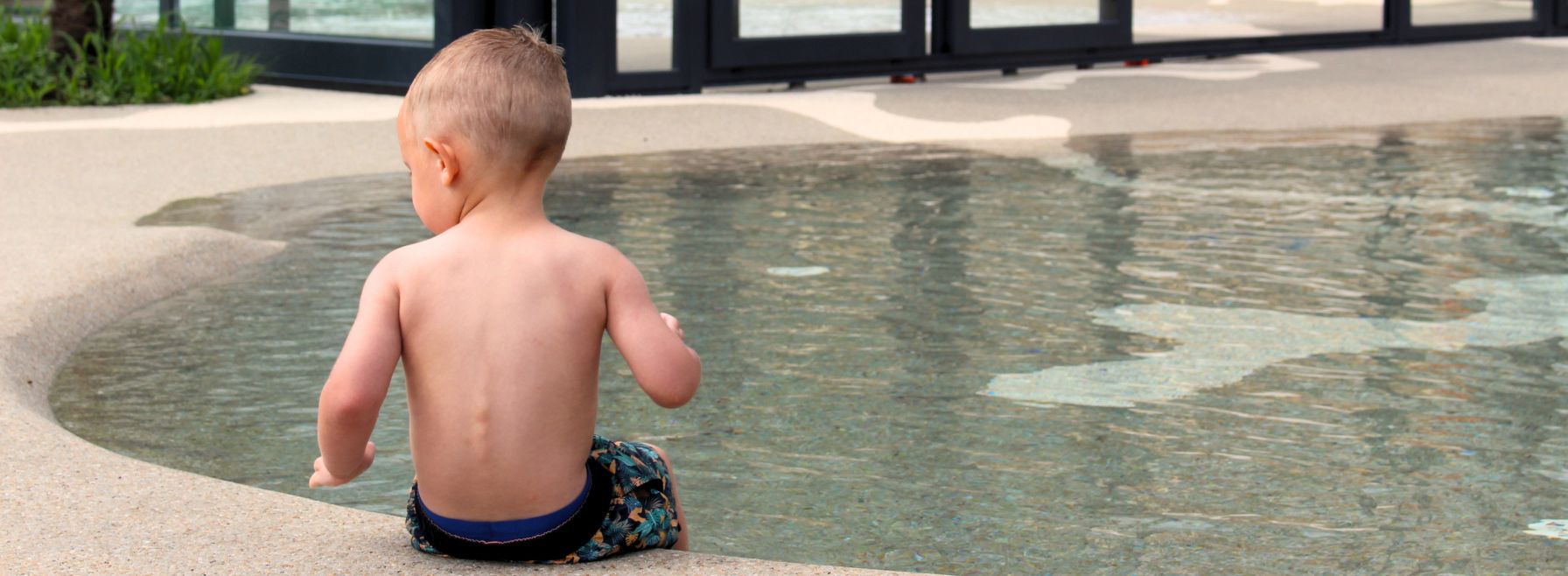
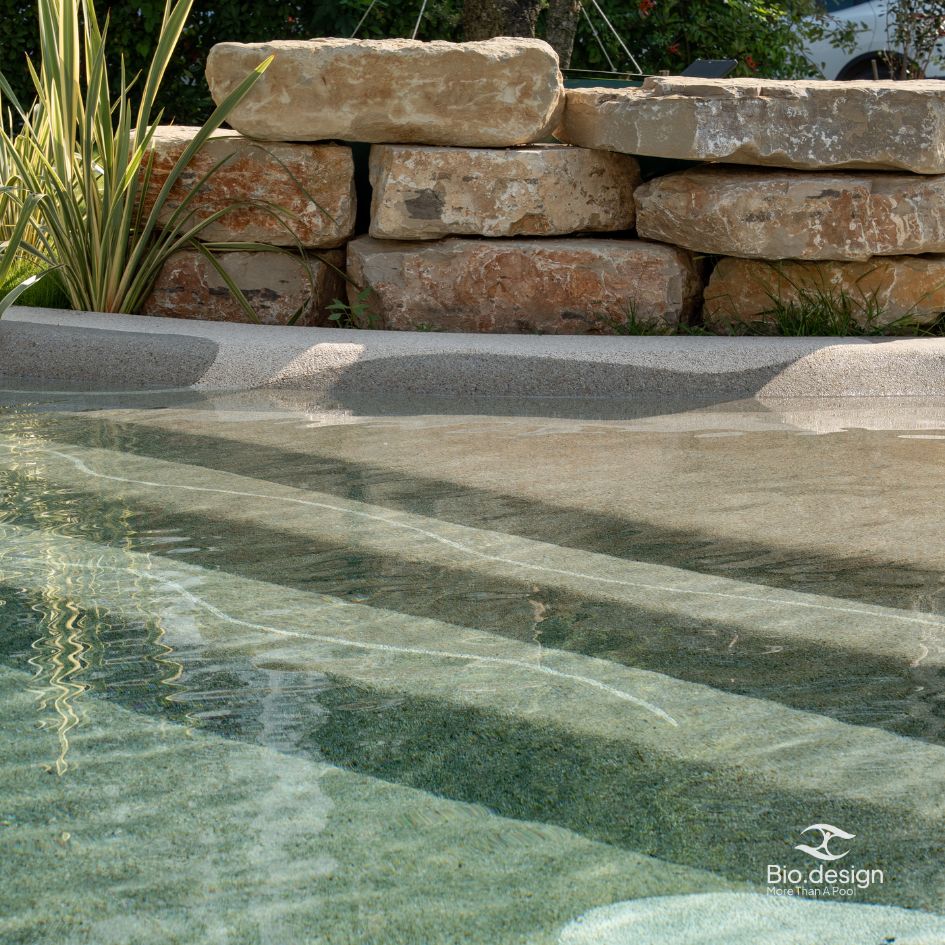
In Bio.design beach pools, beach-style entrances replace traditional ladders, providing gradual access to the water and a progressive perception of depth. This solution improves everyday pool accessibility for children, older people and people with reduced mobility.
The shape of the pool is another distinctive feature. The walls, inclined at approximately 45°, provide natural support around the entire perimeter and allow swimmers, even in deeper areas, to reach a point of support more easily than with traditional vertical walls.
The finish also plays an important role. The Bio.design surface, made with natural quartz and resins, is certified slip-resistant and helps improve grip both in dry areas and along water entrances, reducing the risk of slipping.
These features can be complemented by protection systems such as fencing, self-closing gates, certified pool covers and alarm devices, which are becoming increasingly common in residential pools.
Technology and behaviour: two complementary aspects
Careful design is an important factor in prevention, but it cannot replace responsible behaviour.
The Italian Ministry of Health recommends never leaving children without adult supervision, avoiding diving into water of unknown depth and using appropriate protective equipment when necessary.
Pool safety is therefore the result of integrating design, technology and responsible behaviour by those who use it.
Safety and design can coexist
When designing a Bio.design beach pool, safety, comfort and landscape integration are not separate elements, but aspects that develop together.
Beach-style entrances, slip-resistant surfaces, natural materials and organic shapes combine to create spaces that prioritise accessibility, functionality and quality of experience without compromising the aesthetic value of the project.
A well-designed pool is not only more enjoyable and beautiful to experience: it is also a space designed to provide greater peace of mind for those who use it.

